


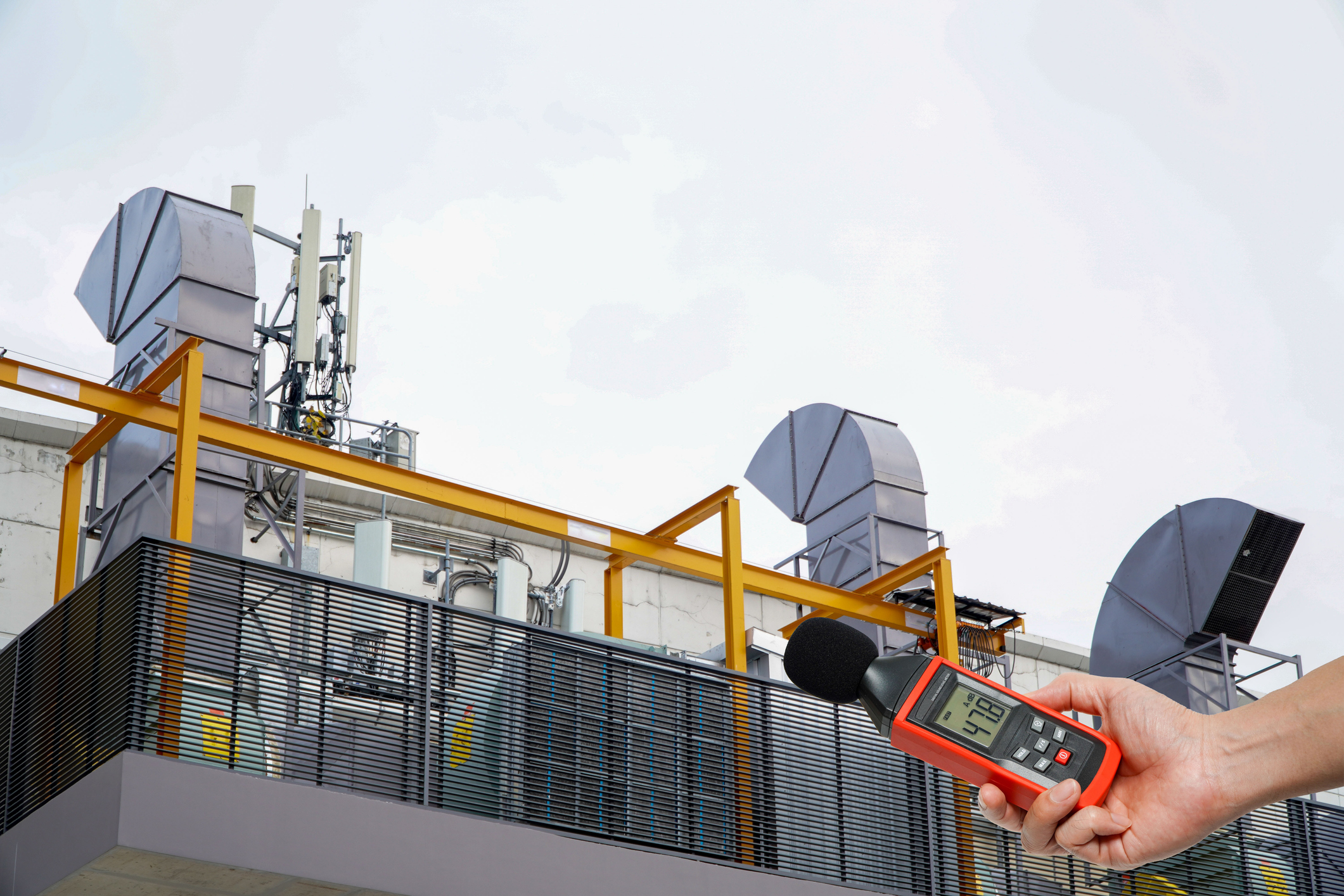
Industrial noise can have an important influence on whether a proposed development is suitable for a particular site, especially where new homes, offices or other noise-sensitive uses are planned near existing commercial or industrial premises.
Factories, workshops, distribution facilities, plant equipment and loading areas can all generate noise as part of their normal operation. In many cases, these activities may have existed for years without causing a planning problem because surrounding land uses are compatible with them.
The situation can change when a new development introduces noise-sensitive occupants nearby.
For developers, the key issue is therefore not simply whether industrial noise exists. It is whether the level, character and timing of that noise could create an unacceptable environment for future occupants, or place pressure on an established business once the development is occupied.
A properly scoped noise assessment can help identify these risks early and provide evidence to support planning decisions.
What types of industrial noise can affect new developments?
Industrial sites can produce many different types of sound, and the character of the noise can be just as important as the overall level.
A steady background hum from fixed plant may be perceived very differently from an intermittent reversing alarm, metal impact noise or loading activity during the night.
Potential industrial sources can include:
- fixed mechanical plant, extraction systems, fans and refrigeration equipment
- loading and unloading operations, vehicle movements, yard activity and reversing alarms
Other sources may include compressors, pumps, manufacturing processes, generators, workshops or equipment that operates periodically rather than continuously.
The consultant assessing the site needs to understand which sources are relevant, when they operate and how their sound reaches the proposed development.
An industrial premises that is relatively quiet during a weekday site visit may operate differently early in the morning, overnight or at weekends. For this reason, the assessment should reflect the periods that are genuinely representative of the site and nearby operations.
Why does existing industrial activity matter during planning?
A new development can change the relationship between an industrial site and its surroundings.
An established business may currently operate without causing significant disturbance because there are no sensitive properties nearby. If residential accommodation is later introduced close to the site, occupants may become exposed to sounds that were not previously problematic.
This can create two planning concerns.
The first is the amenity of the proposed development. Planning authorities need to consider whether future occupants would experience an acceptable noise environment.
The second is the potential effect on the existing business.
If residents subsequently complain about noise from lawful established operations, the business could face pressure to alter working practices, restrict activity or undertake mitigation.
This is why developments near industrial premises need to consider the existing commercial context rather than assuming that the surrounding environment will adapt to the new use.
For developers, understanding this relationship early can prevent potentially serious planning and design problems later.
How are industrial noise impacts assessed?
The assessment normally begins by understanding the proposed development, surrounding land uses and relevant industrial noise sources.
A consultant may review site plans, operating information and nearby receptors before deciding what measurements and analysis are required.
Unlike many planning-related air quality assessments, environmental noise work commonly does require measurements because the existing acoustic environment needs to be understood.
Noise monitoring can be carried out at representative positions around the site or close to relevant noise sources.
The measurements can help establish:
- the existing background sound environment
- the level of industrial or commercial noise at relevant times
- whether specific characteristics such as tones, impulses or intermittency are present
- how noise varies between daytime and night-time periods
The results can then be considered against the proposed development layout and relevant assessment guidance.
The aim is not simply to record the loudest sound found on site. The consultant needs to understand whether the industrial source is likely to create a significant adverse effect at the proposed receptors.
Why is the character of industrial noise important?
Two sounds with similar measured levels can be perceived very differently.
A relatively constant broadband sound may blend into the background, whereas a prominent tonal hum, repeated impact or sudden impulsive sound may draw much more attention.
Intermittency can also matter.
For example, a piece of machinery that operates only periodically may still be noticeable if it creates a distinctive sound that stands out from the surrounding environment.
Likewise, night-time industrial activity can be particularly important because background noise levels are often lower and occupants may be trying to sleep.
This means industrial noise assessment is not simply a matter of comparing one measured number with another.
The nature, duration, timing and acoustic character of the sound all need to be considered.
What role does BS 4142 play?
For many industrial and commercial noise assessments in the UK, BS 4142 is an important reference document.
The standard provides a method for rating and assessing sound of an industrial or commercial nature.
It can be used to consider the relationship between the specific sound from the industrial source and the existing background sound level at the receptor.
Where appropriate, corrections may also be applied to reflect identifiable acoustic characteristics such as tonality, impulsivity or intermittency.
However, the numerical result should not be treated in isolation.
Professional judgement and context remain important.
The consultant may need to consider uncertainty, the existing acoustic environment, the duration and timing of the sound and the specific characteristics of the site.
A competent assessment therefore involves much more than inserting noise levels into a formula.
How can industrial noise affect the design of a development?
Where industrial noise is identified as a potential constraint, the findings can often be used to improve the proposed layout.
The most effective approach is usually to consider noise at the design stage rather than relying entirely on mitigation added afterwards.
For example, less noise-sensitive parts of the development may be positioned closer to the industrial source, while bedrooms, living spaces or other sensitive rooms can be placed in more protected locations.
Building orientation can also make a significant difference.
A development may be arranged so that the building itself provides screening between an industrial source and sensitive facades or outdoor amenity areas.
Other options may include adjusting separation distances, using acoustic barriers or reviewing facade performance.
The correct solution depends on the source, site geometry and intended use.
Early assessment gives the architect and developer more flexibility to explore these measures before the scheme becomes fixed.
Can windows solve an industrial noise problem?
Enhanced glazing can be part of an acoustic design strategy, but it should not automatically be treated as the only solution.
Windows can reduce external noise entering a building when they are closed, but overall performance depends on the complete facade and ventilation strategy.
If occupants need to keep windows closed to achieve suitable internal noise levels, the project team must also consider how fresh air and overheating risks will be managed.
This becomes particularly important for residential developments.
A design that technically achieves an internal target only when every window remains closed may not always provide the most satisfactory living environment.
For this reason, noise should be considered alongside ventilation, thermal comfort and the wider design of the building.
A good assessment should identify the potential constraint early enough for these issues to be coordinated rather than addressed separately at the end of the project.
What about gardens and other outdoor spaces?
Industrial noise can also affect outdoor amenity.
Residential schemes may include private gardens, balconies, terraces or communal spaces that cannot be protected through facade insulation in the same way as internal rooms.
The location of these areas can therefore become an important design consideration.
Where possible, outdoor amenity spaces may be positioned on quieter sides of buildings or screened from the dominant industrial source.
Site layout, building massing and boundary treatments can all influence noise exposure.
This is another example of why acoustic design should be integrated with the overall development layout.
If outdoor areas are designed before the industrial noise environment is properly understood, options for mitigation may become more limited.
Can industrial noise cause planning objections?
Yes.
Existing businesses, planning officers, environmental health teams and local residents may all raise concerns where a proposed noise-sensitive development is close to industrial activity.
An objection may focus on future living conditions, the potential for complaints against an existing business or whether the submitted information demonstrates that noise has been adequately considered.
A well-prepared environmental noise assessment can provide the technical evidence needed to address these questions.
It does not guarantee that an objection will not be made or that planning permission will be granted.
However, it can demonstrate that the relationship between the development and nearby industry has been considered objectively.
Where mitigation or design changes are required, presenting these clearly within the application can also make it easier for decision-makers to understand how the identified risks will be managed.
Why should developers consider noise before buying or designing a site?
Noise constraints can have significant implications for site layout and development capacity.
If a project team only commissions a noise assessment once the design is substantially complete, it may discover that sensitive rooms have been placed on the noisiest elevations or that outdoor areas are difficult to protect.
At that stage, changing the scheme may be more expensive and disruptive.
An early feasibility assessment can help identify whether nearby industrial activity is likely to be a minor consideration or a significant constraint.
This information can then inform land acquisition, design development and planning strategy.
For architects and developers, early acoustic input can therefore be more valuable than treating the noise report as a document needed only for validation of the planning application.
Hawkins Environmental’s wider environmental services can support development teams where noise needs to be considered alongside other planning-related environmental issues.
When should a developer commission an environmental noise assessment?
Developers should seek advice where a proposed noise-sensitive development is located near industrial or commercial operations that could reasonably influence the acoustic environment.
This may include sites close to factories, warehouses, workshops, distribution centres or premises containing significant external plant.
Early assessment is particularly worthwhile where operations extend into evenings or night-time periods, where distinctive noise sources are present, or where the development is being positioned very close to an existing commercial boundary.
The consultant can then advise on the appropriate scope of survey and assessment.
In some cases, the results may show that noise can be managed relatively easily.
In others, the development layout may need more substantial consideration.
Either way, having the information early gives the project team more choices.
Frequently Asked Questions
Does industrial noise automatically prevent residential development?
No. The presence of an industrial or commercial noise source does not automatically make residential development unacceptable. The effect needs to be assessed in the context of the site, proposed use and available design or mitigation measures.
Does an industrial noise assessment always require monitoring?
Environmental noise assessments commonly involve measurements because the existing sound environment and relevant industrial sources need to be characterised. The required survey period and methodology depend on the individual site and operating conditions.
Can noise barriers completely remove industrial noise?
Not necessarily. Barriers can be effective in some situations, but their performance depends on factors such as height, location, source position and the relationship between the source and receptor. They are normally considered as part of a wider acoustic design strategy.
Considering industrial noise before it becomes a constraint
Industrial noise can significantly influence nearby developments, but its presence does not automatically mean that development cannot take place.
The key is understanding the acoustic environment before major planning and design decisions have been finalised.
A properly scoped noise assessment can identify relevant sources, measure existing conditions and determine how the proposed development may be affected. The findings can then inform building orientation, internal layouts, facade design, outdoor amenity spaces and other mitigation where necessary.
Early assessment can also help protect established industrial operators by reducing the risk that a new noise-sensitive development creates an avoidable conflict with existing activities.
For developers, architects and planning teams, this makes environmental noise assessment an important part of evaluating sites where commercial and sensitive uses are located close together.
If you are considering a development near industrial or commercial activity, Hawkins Environmental can assess the existing noise environment and help identify the implications for the proposed scheme. Contact Hawkins Environmental to discuss the site and likely assessment requirements.Phone: 01256 522332
Email: enquiry@hawkinsenvironmental.co.uk
Find out more: hawkinsenvironmental.co